Brisbane’s café and restaurant sector looks active from the street. Coffee shops are busy before school drop-off. Inner-city venues fill during lunch. Suburban dining strips still attract families, workers and weekend customers.
But anyone thinking about opening a café or restaurant in Brisbane needs to look beyond this visible activity. A busy-looking precinct can carry high rent, thin margins, uneven customer demand and strong competition.
A cleaned analysis of 1,380 Brisbane café and restaurant records from the Australian Business Register found 877 active records and 503 not-active records. That means 64 percent of identified records were active, while 36 percent were not active.
That 36 percent figure is not a direct closure rate. Not-active records may include closures, cancelled ABNs, dormant registrations, rebrands, ownership changes, legacy records and owner retirements. But it still provides a useful signal for entrepreneurs: Brisbane hospitality has a large active market, but it also carries a high level of business movement.
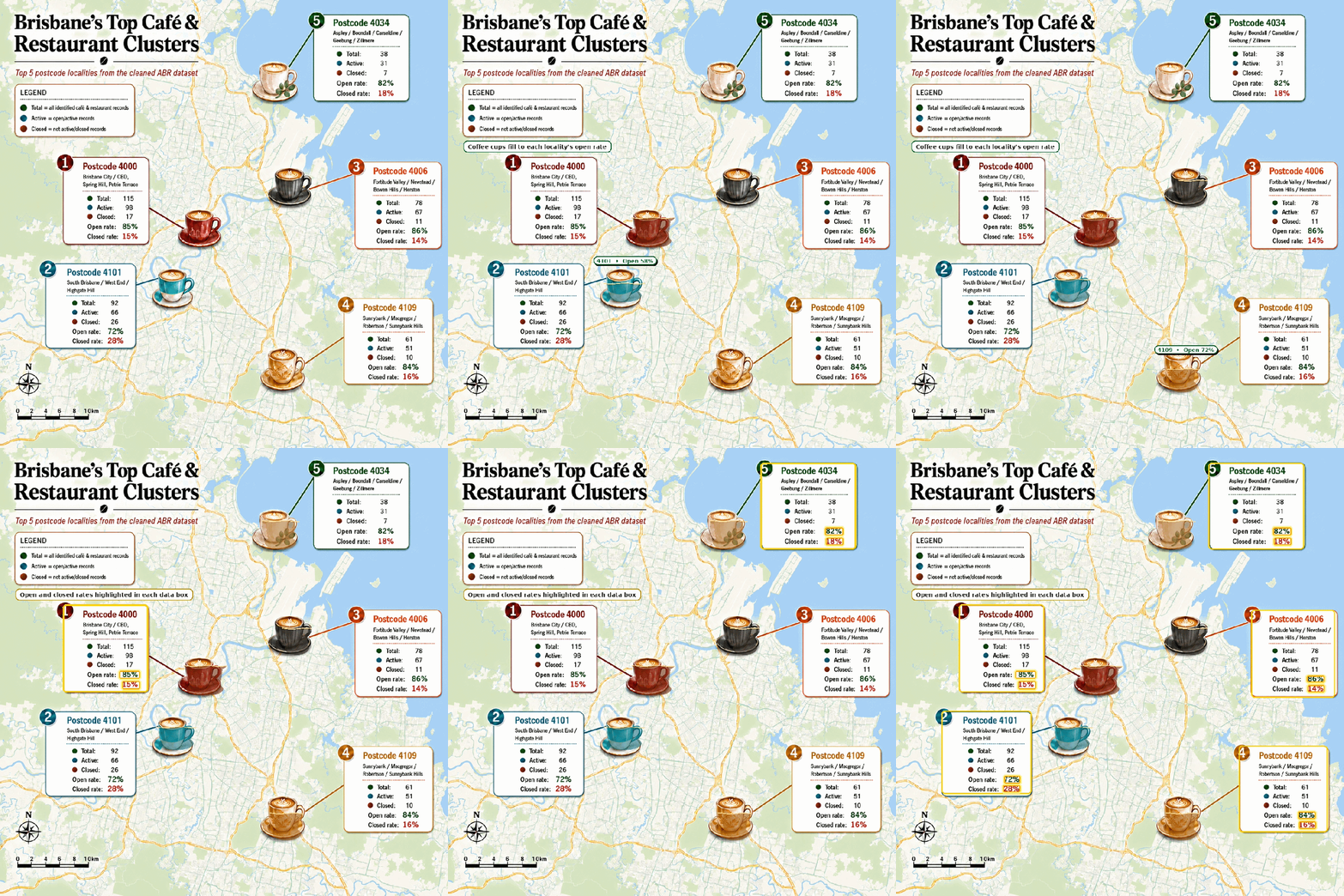
The clearest opportunity appears in five postcode clusters: 4000, 4101, 4006, 4109 and 4034. Together, these five areas accounted for 384 of the 1,380 records, or 28 percent of the cleaned dataset. They also accounted for 313 active records, or 36 percent of all active records.
Brisbane’s top five café and restaurant postcode clusters accounted for 384 identified records and 313 active records. This map shows where activity, density and risk are concentrated across the city.
For a new operator, this map is the best starting point. It does not show guaranteed success. Instead, it shows where café and restaurant activity is already concentrated, where customer markets may exist and where competition may also be strongest.
This ABR dataset was used because it is ABN-centred, entity-based and better suited to identifying business status, location and industry classification than business-name-only sources.
The first step narrowed the national dataset to Queensland records. The second step filtered for café, restaurant, takeaway and foodservice-related entities. This produced a smaller group of potentially relevant businesses, but it still included records that needed manual checking.
The raw data included noise. Some records involved cancelled registrations, unclear trading names, duplicate records, non-hospitality entities, historic records or businesses that no longer appeared to trade under the recorded structure.
The dataset therefore went through automated cleaning and manual verification. The process checked business names, ABNs, suburbs, postcodes, trading status, category relevance and public listing evidence.
Brisbane City Council suburb boundary sources helped verify whether records belonged within the Brisbane City Local Government Area (LGA). Australia Post postcode references helped check locality labels for the top postcode clusters. Google Maps public listings, websites and social media pages were also used as public-facing cross-checks for individual business status.
These public listings were not treated as definitive proof. They were used as cross-checks only, because online listings can lag behind real trading conditions. Where possible, public listing signals were compared with ABR status and other public evidence.
The final cleaned dataset identified 1,380 Brisbane café and restaurant records.
After this process, 1,380 Brisbane café and restaurant records remained. Of those, 877 were active and 503 were not active.
4000: Brisbane’s biggest café and restaurant cluster
Postcode 4000, covering Brisbane City, Spring Hill and Petrie Terrace, recorded the highest concentration of café and restaurant records in the dataset.
It had 115 records, with 98 active and 17 not active. That produced an 85 percent open rate.
For entrepreneurs, this area offers scale. It sits around office workers, visitors, students, hotels, events and commuter traffic. That kind of customer flow can support cafés and restaurants, especially those with strong weekday trade.
But the dataset cannot prove that customer volume offsets the cost base. A CBD location may also involve higher rent, higher staffing requirements, longer trading hours and stronger competition.
The practical takeaway: 4000 may suit operators with capital, clear positioning and the ability to handle a higher fixed-cost environment.
4006: the strongest open rate among the top five
Postcode 4006, covering Fortitude Valley, Newstead, Bowen Hills and Herston, recorded 78 café and restaurant records. Of those, 67 were active and 11 were not active.
That produced an 86 percent open rate, the strongest among the top five clusters.
For entrepreneurs, 4006 offers a mix of hospitality demand. Fortitude Valley has nightlife and entertainment activity. Newstead and Bowen Hills include residential growth, offices and destination venues. Herston adds health and hospital-related activity.
This diversity may support different trading windows: breakfast, lunch, dinner, takeaway and weekend demand. But it also means competition can be intense. A new entrant needs a strong reason for customers to switch or add another venue to their routine.
The practical takeaway: 4006 may suit operators with a sharp brand, strong design, delivery potential or a food offer that fits a competitive precinct.
4109: Brisbane’s major southern dining cluster
Postcode 4109, covering Sunnybank, Macgregor, Robertson, Sunnybank Hills and Sunnybank South, recorded 61 café and restaurant records. Of those, 51 were active and 10 were not active.
That produced an 84 percent open rate.
For entrepreneurs, 4109 is one of the clearest suburban signals in the dataset. It has an established dining identity and strong local recognition as a southern food cluster.
This type of locality can benefit from repeat customers, family dining, evening trade, takeaway demand and cultural food depth. But established dining areas can also be hard to enter. Customers may already have trusted favourites, and a new business may need quality, price discipline and a clear point of difference.
The practical takeaway: 4109 may suit operators with a strong cuisine focus, family dining model, takeaway strategy or community-based brand.
4034: smaller but stable northern suburban activity
Postcode 4034, covering Aspley, Boondall, Carseldine, Geebung and Zillmere, recorded 38 café and restaurant records. Of those, 31 were active and seven were not active.
That produced an 82 percent open rate.
This is not the largest cluster, but it still shows a meaningful northern suburban market. For a café or restaurant operator, a smaller cluster can be useful where the business depends on local repeat trade rather than high tourist or nightlife activity.
The main trade-off is visibility. A suburban location may have lower rent exposure than an inner-city precinct, but it may also require more consistent local loyalty. Operators may need to rely on morning routines, school traffic, nearby workers, families and weekend habits.
The practical takeaway: 4034 may suit operators with a neighbourhood café model, low-to-moderate overheads and strong local marketing.
4101: visible, popular and riskier than it looks
Postcode 4101, covering South Brisbane, West End and Highgate Hill, recorded 92 café and restaurant records. That made it the second-largest cluster in the dataset.
But it had the lowest open rate among the top five clusters: 72 percent. Of its 92 records, 66 were active and 26 were not active.
This is the most interesting finding for entrepreneurs.
South Brisbane and West End look like obvious hospitality locations. They have apartments, nightlife, arts activity, students, workers and visitors. They also have strong public visibility and an established food culture.
Yet the data shows a higher inactive share than the other leading clusters. That does not mean entrepreneurs should avoid 4101. It means the area may reward strong operators while exposing weak concepts quickly.
A venue in 4101 may need to compete harder on brand, menu, experience, price, location and trading hours. It may also need enough capital to survive the early months before regular demand settles.
The practical takeaway: 4101 may suit experienced operators, destination venues and concepts with strong differentiation. It may be less forgiving for under-capitalised first-time entrants.
What interviews revealed about business pressure
The numbers show where activity is concentrated. Interviews show what it feels like to operate inside that market.
Six owner, manager and staff interviews were thematically coded identifying: cost pressure, uneven demand, confidence level, price pressure, hidden instability and low-overhead strategy.
Across the six interviews, cost pressure appeared 31 times, uneven demand appeared 27 times and hidden instability appeared 26 times. Confidence level appeared 18 times, price pressure appeared 9 times and low-overhead strategy appeared 5 times.
Thematic coding from interview responses found repeated references to cost pressure, uneven demand and hidden instability across six owner, manager and staff interviews.
Hidden instability refers to signs that a café or restaurant may be operating under pressure despite still being open, trading or appearing busy. Examples include break-even trading, weak profitability, product waste, high fixed costs, owner concern, uneven demand and revenue that does not consistently cover costs.
One new café owner described trading as “up and down.”
The business was still open, still building a customer base and still hopeful. But rent, tax, EFTPOS fees, supplier levies and inventory costs were all adding pressure.
Another operator, running a mobile coffee model, described a more stable position. The business had operated from the same location for about 10 years, and customer numbers were broadly consistent with the previous year. Its lower-risk structure came from low overheads and family labour.
A suburban café owner offered another lesson. The business was profitable and the owner felt confident, but the model relied on keeping staff costs low. The owner said the business was surviving because it had no staff.
Another café and restaurant manager provided a stronger counter-example. Their business reported steady year-on-year performance, strong tourist demand and a positive outlook, despite weather and wage pressure.
These in-person experiences suggest that the best business model depends heavily on fixed costs. A shopfront café with rent, staff and equipment costs carries a different risk profile from a mobile coffee trailer or family-run suburban café.
Industry context: busy does not mean comfortable
Restaurant & Catering Australia (RCA) President, Lincoln John Hart described Brisbane’s café and restaurant sector as “visibly busy but structurally stretched.”
He stated not every inactive ABN represents a failed business. Ownership transfers, restructures and rebrands are common in hospitality. But he also identified high competition, low barriers to entry and thin margins as core sector pressures.
Hart emphasised that national café margins sit at about 2.6 percent and restaurant margins at about 2.8 percent. That means a venue can look busy while the owner still faces a tight financial result after rent, wages, stock, energy, tax and fees.
The national context also matters. RCA reported in February 2026 that 10.4 percent of foodservice businesses had closed in the previous 12 months, which it described as the highest failure rate of any sector in the economy.
Business Chamber Queensland’s December 2025 Pulse Report reported softer business confidence across Queensland, linked to inflation, operating costs and broader economic pressure.
For entrepreneurs, the message is clear. Hospitality demand exists, but demand alone does not make a viable business.
Where should you open?
The answer depends on the business model.
If the priority is foot traffic, 4000 remains the largest cluster. If the priority is the strongest open-rate signal among the top five, 4006 stands out. If the goal is a suburban dining audience, 4109 deserves close attention. If the model relies on local repeat trade and lower exposure, 4034 may be worth deeper research. If the concept is strong and the operator can handle competition, 4101 may still offer opportunity, despite its higher inactive share.
The key is not to choose a suburb because it looks busy. Instead, choose a locality only after testing the rent, staffing model, target customer, trading hours, price point, competition and cash buffer.
Brisbane’s café and restaurant sector is large, active and locally important. But the data shows that visible popularity does not always mean commercial security. For entrepreneurs, the best postcode is not always the busiest one. It is the one where the business model, customer base, rent, labour structure and price point all fit together.


 juni
juni 
OPINION |
Brisbane’s café and restaurant sector looks active from the street. Coffee shops are busy before school drop-off. Inner-city venues fill during lunch. Suburban dining strips still attract families, workers and weekend customers.
But anyone thinking about opening a café or restaurant in Brisbane needs to look beyond this visible activity. A busy-looking precinct can carry high rent, thin margins, uneven customer demand and strong competition.
A cleaned analysis of 1,380 Brisbane café and restaurant records from the Australian Business Register found 877 active records and 503 not-active records. That means 64 percent of identified records were active, while 36 percent were not active.
That 36 percent figure is not a direct closure rate. Not-active records may include closures, cancelled ABNs, dormant registrations, rebrands, ownership changes, legacy records and owner retirements. But it still provides a useful signal for entrepreneurs: Brisbane hospitality has a large active market, but it also carries a high level of business movement.
The clearest opportunity appears in five postcode clusters: 4000, 4101, 4006, 4109 and 4034. Together, these five areas accounted for 384 of the 1,380 records, or 28 percent of the cleaned dataset. They also accounted for 313 active records, or 36 percent of all active records.
For a new operator, this map is the best starting point. It does not show guaranteed success. Instead, it shows where café and restaurant activity is already concentrated, where customer markets may exist and where competition may also be strongest.
ABR dataset was analysed
The analysis started with the publicly available Australian Business Register (ABR) national dataset (as at 27 February 2026).
This ABR dataset was used because it is ABN-centred, entity-based and better suited to identifying business status, location and industry classification than business-name-only sources.
The first step narrowed the national dataset to Queensland records. The second step filtered for café, restaurant, takeaway and foodservice-related entities. This produced a smaller group of potentially relevant businesses, but it still included records that needed manual checking.
The raw data included noise. Some records involved cancelled registrations, unclear trading names, duplicate records, non-hospitality entities, historic records or businesses that no longer appeared to trade under the recorded structure.
The dataset therefore went through automated cleaning and manual verification. The process checked business names, ABNs, suburbs, postcodes, trading status, category relevance and public listing evidence.
Brisbane City Council suburb boundary sources helped verify whether records belonged within the Brisbane City Local Government Area (LGA). Australia Post postcode references helped check locality labels for the top postcode clusters. Google Maps public listings, websites and social media pages were also used as public-facing cross-checks for individual business status.
These public listings were not treated as definitive proof. They were used as cross-checks only, because online listings can lag behind real trading conditions. Where possible, public listing signals were compared with ABR status and other public evidence.
After this process, 1,380 Brisbane café and restaurant records remained. Of those, 877 were active and 503 were not active.
4000: Brisbane’s biggest café and restaurant cluster
Postcode 4000, covering Brisbane City, Spring Hill and Petrie Terrace, recorded the highest concentration of café and restaurant records in the dataset.
It had 115 records, with 98 active and 17 not active. That produced an 85 percent open rate.
For entrepreneurs, this area offers scale. It sits around office workers, visitors, students, hotels, events and commuter traffic. That kind of customer flow can support cafés and restaurants, especially those with strong weekday trade.
But the dataset cannot prove that customer volume offsets the cost base. A CBD location may also involve higher rent, higher staffing requirements, longer trading hours and stronger competition.
The practical takeaway: 4000 may suit operators with capital, clear positioning and the ability to handle a higher fixed-cost environment.
4006: the strongest open rate among the top five
Postcode 4006, covering Fortitude Valley, Newstead, Bowen Hills and Herston, recorded 78 café and restaurant records. Of those, 67 were active and 11 were not active.
That produced an 86 percent open rate, the strongest among the top five clusters.
For entrepreneurs, 4006 offers a mix of hospitality demand. Fortitude Valley has nightlife and entertainment activity. Newstead and Bowen Hills include residential growth, offices and destination venues. Herston adds health and hospital-related activity.
This diversity may support different trading windows: breakfast, lunch, dinner, takeaway and weekend demand. But it also means competition can be intense. A new entrant needs a strong reason for customers to switch or add another venue to their routine.
The practical takeaway: 4006 may suit operators with a sharp brand, strong design, delivery potential or a food offer that fits a competitive precinct.
4109: Brisbane’s major southern dining cluster
Postcode 4109, covering Sunnybank, Macgregor, Robertson, Sunnybank Hills and Sunnybank South, recorded 61 café and restaurant records. Of those, 51 were active and 10 were not active.
That produced an 84 percent open rate.
For entrepreneurs, 4109 is one of the clearest suburban signals in the dataset. It has an established dining identity and strong local recognition as a southern food cluster.
This type of locality can benefit from repeat customers, family dining, evening trade, takeaway demand and cultural food depth. But established dining areas can also be hard to enter. Customers may already have trusted favourites, and a new business may need quality, price discipline and a clear point of difference.
The practical takeaway: 4109 may suit operators with a strong cuisine focus, family dining model, takeaway strategy or community-based brand.
4034: smaller but stable northern suburban activity
Postcode 4034, covering Aspley, Boondall, Carseldine, Geebung and Zillmere, recorded 38 café and restaurant records. Of those, 31 were active and seven were not active.
That produced an 82 percent open rate.
This is not the largest cluster, but it still shows a meaningful northern suburban market. For a café or restaurant operator, a smaller cluster can be useful where the business depends on local repeat trade rather than high tourist or nightlife activity.
The main trade-off is visibility. A suburban location may have lower rent exposure than an inner-city precinct, but it may also require more consistent local loyalty. Operators may need to rely on morning routines, school traffic, nearby workers, families and weekend habits.
The practical takeaway: 4034 may suit operators with a neighbourhood café model, low-to-moderate overheads and strong local marketing.
4101: visible, popular and riskier than it looks
Postcode 4101, covering South Brisbane, West End and Highgate Hill, recorded 92 café and restaurant records. That made it the second-largest cluster in the dataset.
But it had the lowest open rate among the top five clusters: 72 percent. Of its 92 records, 66 were active and 26 were not active.
This is the most interesting finding for entrepreneurs.
South Brisbane and West End look like obvious hospitality locations. They have apartments, nightlife, arts activity, students, workers and visitors. They also have strong public visibility and an established food culture.
Yet the data shows a higher inactive share than the other leading clusters. That does not mean entrepreneurs should avoid 4101. It means the area may reward strong operators while exposing weak concepts quickly.
A venue in 4101 may need to compete harder on brand, menu, experience, price, location and trading hours. It may also need enough capital to survive the early months before regular demand settles.
The practical takeaway: 4101 may suit experienced operators, destination venues and concepts with strong differentiation. It may be less forgiving for under-capitalised first-time entrants.
What interviews revealed about business pressure
The numbers show where activity is concentrated. Interviews show what it feels like to operate inside that market.
Six owner, manager and staff interviews were thematically coded identifying: cost pressure, uneven demand, confidence level, price pressure, hidden instability and low-overhead strategy.
Across the six interviews, cost pressure appeared 31 times, uneven demand appeared 27 times and hidden instability appeared 26 times. Confidence level appeared 18 times, price pressure appeared 9 times and low-overhead strategy appeared 5 times.
hidden instability across six owner, manager and staff interviews.
Hidden instability refers to signs that a café or restaurant may be operating under pressure despite still being open, trading or appearing busy. Examples include break-even trading, weak profitability, product waste, high fixed costs, owner concern, uneven demand and revenue that does not consistently cover costs.
One new café owner described trading as “up and down.”
The business was still open, still building a customer base and still hopeful. But rent, tax, EFTPOS fees, supplier levies and inventory costs were all adding pressure.
Another operator, running a mobile coffee model, described a more stable position. The business had operated from the same location for about 10 years, and customer numbers were broadly consistent with the previous year. Its lower-risk structure came from low overheads and family labour.
A suburban café owner offered another lesson. The business was profitable and the owner felt confident, but the model relied on keeping staff costs low. The owner said the business was surviving because it had no staff.
Another café and restaurant manager provided a stronger counter-example. Their business reported steady year-on-year performance, strong tourist demand and a positive outlook, despite weather and wage pressure.
These in-person experiences suggest that the best business model depends heavily on fixed costs. A shopfront café with rent, staff and equipment costs carries a different risk profile from a mobile coffee trailer or family-run suburban café.
Industry context: busy does not mean comfortable
Restaurant & Catering Australia (RCA) President, Lincoln John Hart described Brisbane’s café and restaurant sector as “visibly busy but structurally stretched.”
He stated not every inactive ABN represents a failed business. Ownership transfers, restructures and rebrands are common in hospitality. But he also identified high competition, low barriers to entry and thin margins as core sector pressures.
Hart emphasised that national café margins sit at about 2.6 percent and restaurant margins at about 2.8 percent. That means a venue can look busy while the owner still faces a tight financial result after rent, wages, stock, energy, tax and fees.
The national context also matters. RCA reported in February 2026 that 10.4 percent of foodservice businesses had closed in the previous 12 months, which it described as the highest failure rate of any sector in the economy.
Business Chamber Queensland’s December 2025 Pulse Report reported softer business confidence across Queensland, linked to inflation, operating costs and broader economic pressure.
For entrepreneurs, the message is clear. Hospitality demand exists, but demand alone does not make a viable business.
Where should you open?
The answer depends on the business model.
If the priority is foot traffic, 4000 remains the largest cluster. If the priority is the strongest open-rate signal among the top five, 4006 stands out. If the goal is a suburban dining audience, 4109 deserves close attention. If the model relies on local repeat trade and lower exposure, 4034 may be worth deeper research. If the concept is strong and the operator can handle competition, 4101 may still offer opportunity, despite its higher inactive share.
The key is not to choose a suburb because it looks busy. Instead, choose a locality only after testing the rent, staffing model, target customer, trading hours, price point, competition and cash buffer.
Brisbane’s café and restaurant sector is large, active and locally important. But the data shows that visible popularity does not always mean commercial security. For entrepreneurs, the best postcode is not always the busiest one. It is the one where the business model, customer base, rent, labour structure and price point all fit together.
This work is licensed under a Creative Commons Attribution-NonCommercial-NoDerivatives 4.0 International License