This week’s standout on the Australian market was Austal Ltd, whose share price surged well ahead of the broader index. The move was not random. It reflects a deeper market shift towards defence, industrial capability and state-backed revenue certainty at a time of global instability.
Why Austal Ltd outperformed this week
Austal Ltd benefited from renewed investor attention on defence and shipbuilding as strategic assets. As capital rotated away from cyclical resource exposure and into companies aligned with long-term government spending, Austal emerged as a clear beneficiary. The rally coincided with broader strength in technology and industrial stocks, but Austal’s gains were stock-specific rather than index-driven.
Austal’s strong weekly performance signals a market preference for firms with predictable cash flows, sovereign-backed contracts, and insulation from consumer demand cycles. Defence spending, not sentiment, drove the move. For investors, this week was less about momentum and more about positioning ahead of a structurally different capital cycle.
What Moved the Stock
Several forces converged during the week:
Heightened focus on defence and national industrial capability.
Ongoing geopolitical tension reinforcing naval and maritime investment.
Increased institutional interest in mid-cap defence-linked equities.
Strong relative performance within the industrial and technology segments of the market.
Austal’s rally highlights a broader recalibration in Australian equities. Markets are pricing durability over growth and state-backed revenue over discretionary exposure. Defence manufacturers now sit closer to infrastructure plays than traditional cyclicals. That matters for portfolio construction in a higher-risk global environment.
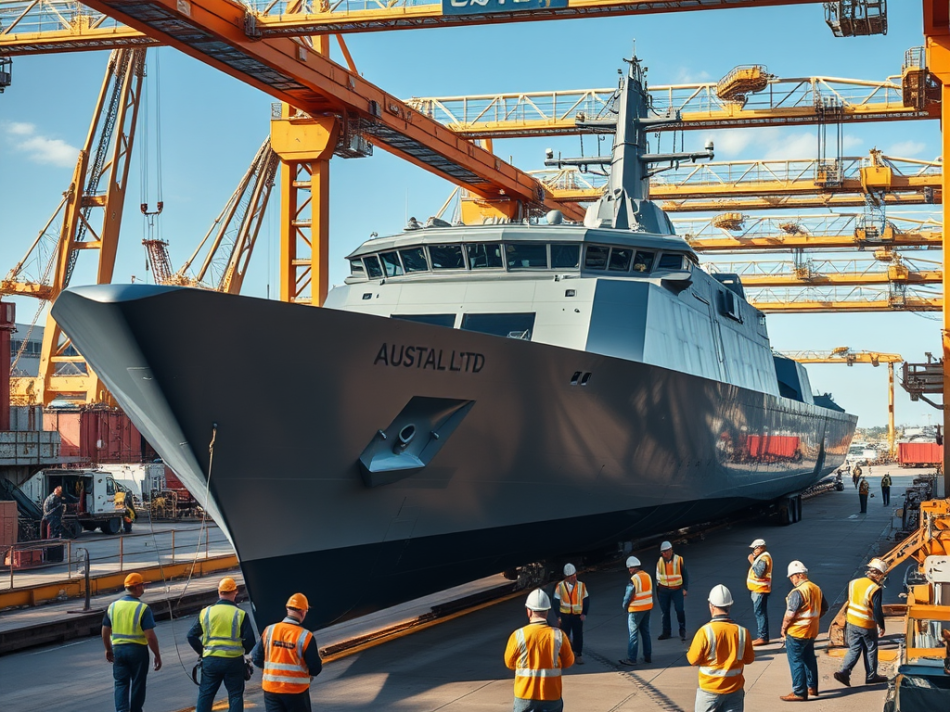
As an Australian-based global shipbuilder specialising in defence vessels and high-speed commercial ships, the company’s operations span Australia, United States and Asia, with defence contracts forming the core of its revenue base.
Market capitalisation: Mid-cap ASX range (varies with price movement)
Sector: Defence and industrial manufacturing
Core Revenue Drivers
Austal’s revenues are concentrated in:
Naval and defence shipbuilding for government clients.
Long-term sustainment and support contracts.
Commercial shipbuilding, primarily ferries and specialist vessels.
The defence component dominates margins and provides revenue visibility over multiple years.
Over the week, the company delivered one of the strongest gains on the Australian market, materially outperforming the S&P/ASX 200, which recorded only modest movement. The divergence underscores that this was not a passive market rally but a targeted re-rating.
Trading volumes rose above recent averages, suggesting institutional participation rather than retail speculation.
Recent earnings have shown steady revenue supported by defence contracts, with margins holding despite cost pressures affecting parts of the industrial sector. Guidance remains stable, with management signalling confidence in the existing project pipeline rather than relying on speculative future awards.
The balance sheet remains sound for a capital-intensive business. Debt levels are manageable, liquidity is adequate and cash flow timing aligns with long-cycle government contracts.
Austal occupies a defensible niche in Australian defence manufacturing. The barriers to entry are high, competition is limited and the company benefits from long-standing relationships with government clients. In an environment where governments prioritise domestic capability, this positioning carries strategic value beyond near-term earnings.
The company is exposed to:
Government defence budgets.
Procurement policy shifts.
Geopolitical developments that influence naval investment.
These factors tend to be binary but also long-dated, reinforcing revenue stability once contracts are secured.
Risks
Short-term risks
Profit-taking following a sharp price increase.
Delays or deferrals in contract announcements.
Structural risks
Capital intensity and project execution risk.
Dependence on government procurement cycles.
Exposure to political change in key defence markets.
Austal’s performance this week reflects more than enthusiasm. It reflects capital reallocating towards companies aligned with sovereign priorities and long-term spending commitments. While volatility is inevitable after a rapid move, the underlying thesis remains intact.
Rating: Accumulate on weakness
Time horizon: Medium term (three to twelve months)
For investors seeking exposure to defence, industrial capability, and state-backed revenue, Austal now sits firmly on the market’s radar.


 juni
juni 
OPINION |
This week’s standout on the Australian market was Austal Ltd, whose share price surged well ahead of the broader index. The move was not random. It reflects a deeper market shift towards defence, industrial capability and state-backed revenue certainty at a time of global instability.
Why Austal Ltd outperformed this week
Austal Ltd benefited from renewed investor attention on defence and shipbuilding as strategic assets. As capital rotated away from cyclical resource exposure and into companies aligned with long-term government spending, Austal emerged as a clear beneficiary. The rally coincided with broader strength in technology and industrial stocks, but Austal’s gains were stock-specific rather than index-driven.
Austal’s strong weekly performance signals a market preference for firms with predictable cash flows, sovereign-backed contracts, and insulation from consumer demand cycles. Defence spending, not sentiment, drove the move. For investors, this week was less about momentum and more about positioning ahead of a structurally different capital cycle.
What Moved the Stock
Several forces converged during the week:
Austal’s rally highlights a broader recalibration in Australian equities. Markets are pricing durability over growth and state-backed revenue over discretionary exposure. Defence manufacturers now sit closer to infrastructure plays than traditional cyclicals. That matters for portfolio construction in a higher-risk global environment.
As an Australian-based global shipbuilder specialising in defence vessels and high-speed commercial ships, the company’s operations span Australia, United States and Asia, with defence contracts forming the core of its revenue base.
Core Revenue Drivers
Austal’s revenues are concentrated in:
The defence component dominates margins and provides revenue visibility over multiple years.
Over the week, the company delivered one of the strongest gains on the Australian market, materially outperforming the S&P/ASX 200, which recorded only modest movement. The divergence underscores that this was not a passive market rally but a targeted re-rating.
Trading volumes rose above recent averages, suggesting institutional participation rather than retail speculation.
Recent earnings have shown steady revenue supported by defence contracts, with margins holding despite cost pressures affecting parts of the industrial sector. Guidance remains stable, with management signalling confidence in the existing project pipeline rather than relying on speculative future awards.
The balance sheet remains sound for a capital-intensive business. Debt levels are manageable, liquidity is adequate and cash flow timing aligns with long-cycle government contracts.
Austal occupies a defensible niche in Australian defence manufacturing. The barriers to entry are high, competition is limited and the company benefits from long-standing relationships with government clients. In an environment where governments prioritise domestic capability, this positioning carries strategic value beyond near-term earnings.
The company is exposed to:
These factors tend to be binary but also long-dated, reinforcing revenue stability once contracts are secured.
Risks
Short-term risks
Structural risks
Austal’s performance this week reflects more than enthusiasm. It reflects capital reallocating towards companies aligned with sovereign priorities and long-term spending commitments. While volatility is inevitable after a rapid move, the underlying thesis remains intact.
For investors seeking exposure to defence, industrial capability, and state-backed revenue, Austal now sits firmly on the market’s radar.
This work is licensed under a Creative Commons Attribution-NonCommercial-NoDerivatives 4.0 International License