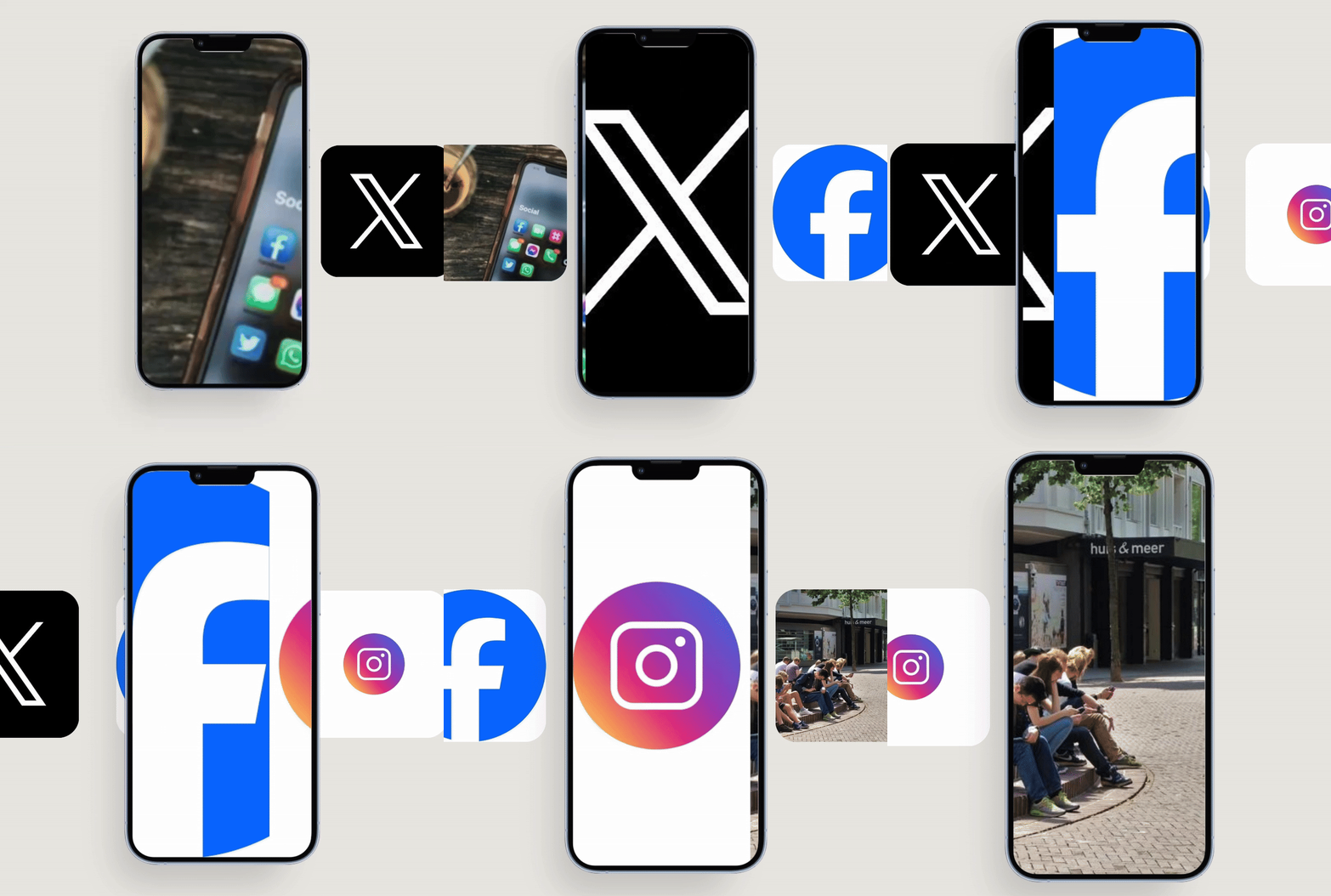
It has been 1 Month since Australia took the bold step of prohibiting social media use for people below the age of 16, on the 10th of December, 2025. It became the very first nation to do so.
The Online Safety Amendment (Social Media Minimum Age) Act 2024, which is an amendment to the Online Safety Act 2021, stipulated that major social media platforms must adopt “reasonable steps” to stop Australian users who are under the age of 16 from creating or maintaining accounts on their services. The noncompliance of the platforms would result in hefty fines of up to AUD $49.5 million (~USD $33 million) for repeated or serious violations.
The Policy’s Main Objective: Children’s Safety and Prevention of Online Harms
The Australian government, led by Labor Prime Minister, Anthony Albanese has advocated for this law, to act as a child protection tool by pointing out the increased susceptibility of younger adolescents to various harms such as cyber-bullying and viewing dangerous content. Controversially, the law has made it the responsibility of the platforms to regulate instead of the children and their parents.
Legal Challenge and Freedom of Expression Debate
The social media ban sparked legal challenges. In December 2025, Reddit filed a case in the High Court of Australia, arguing that the law infringes the Constitution’s implied freedom of political communication by restricting how young people engage in public discourse online. A prior challenge was also launched by the Digital Freedom Project alongside teenage plaintiffs.
Human rights and advocacy groups had similarly raised concerns that the law could limit young people’s access to accurate information, social connection and support networks (e.g. rights often associated with freedom of expression and association) and that the reliance on age-verification technologies raises privacy questions.
Implementation Challenges & Technology
Enforcement of the ban has depended on age-assurance methods employed by platforms, such as age inference (using data signals to estimate age), age estimation (e.g., biometrics) and verified age checks. There is no single technology specified and platforms have had to balance accuracy, privacy and practicality when complying. The law has also specified that platforms cannot require government ID and must provide reasonable alternatives to meet age requirements.
Public Reaction & Broader Implications
Public opinion in Australia has been mixed. Some parents and advocacy groups support the ban as a necessary protection against online harms, while critics including youth organisations and civil liberties advocates, have raised concerns about social isolation, reduced access to accurate information and the effectiveness of the ban in an environment where teens use virtual private networks (VPNs) or simply migrate to other unregulated platforms.
The policy has been a topic of great interest and debate internationally. Countries like Denmark, Malaysia and Norway, as well as the European Union, have held similar discussions revolving around age-related social media restrictions and digital safety frameworks.


 juni
juni 
OPINION |
It has been 1 Month since Australia took the bold step of prohibiting social media use for people below the age of 16, on the 10th of December, 2025. It became the very first nation to do so.
The Online Safety Amendment (Social Media Minimum Age) Act 2024, which is an amendment to the Online Safety Act 2021, stipulated that major social media platforms must adopt “reasonable steps” to stop Australian users who are under the age of 16 from creating or maintaining accounts on their services. The noncompliance of the platforms would result in hefty fines of up to AUD $49.5 million (~USD $33 million) for repeated or serious violations.
The Policy’s Main Objective: Children’s Safety and Prevention of Online Harms
The Australian government, led by Labor Prime Minister, Anthony Albanese has advocated for this law, to act as a child protection tool by pointing out the increased susceptibility of younger adolescents to various harms such as cyber-bullying and viewing dangerous content. Controversially, the law has made it the responsibility of the platforms to regulate instead of the children and their parents.
Legal Challenge and Freedom of Expression Debate
The social media ban sparked legal challenges. In December 2025, Reddit filed a case in the High Court of Australia, arguing that the law infringes the Constitution’s implied freedom of political communication by restricting how young people engage in public discourse online. A prior challenge was also launched by the Digital Freedom Project alongside teenage plaintiffs.
Human rights and advocacy groups had similarly raised concerns that the law could limit young people’s access to accurate information, social connection and support networks (e.g. rights often associated with freedom of expression and association) and that the reliance on age-verification technologies raises privacy questions.
Implementation Challenges & Technology
Enforcement of the ban has depended on age-assurance methods employed by platforms, such as age inference (using data signals to estimate age), age estimation (e.g., biometrics) and verified age checks. There is no single technology specified and platforms have had to balance accuracy, privacy and practicality when complying. The law has also specified that platforms cannot require government ID and must provide reasonable alternatives to meet age requirements.
Public Reaction & Broader Implications
Public opinion in Australia has been mixed. Some parents and advocacy groups support the ban as a necessary protection against online harms, while critics including youth organisations and civil liberties advocates, have raised concerns about social isolation, reduced access to accurate information and the effectiveness of the ban in an environment where teens use virtual private networks (VPNs) or simply migrate to other unregulated platforms.
The policy has been a topic of great interest and debate internationally. Countries like Denmark, Malaysia and Norway, as well as the European Union, have held similar discussions revolving around age-related social media restrictions and digital safety frameworks.
This work is licensed under a Creative Commons Attribution-NonCommercial-NoDerivatives 4.0 International License