Ram, Ram. A warm greeting said by millions around the world with care, respect and well wishes.
The person attributed with this greeting is Valmiki, an ancient Indian sage and poet. He is revered as the author of the Sanskrit scripture, the Ramayana, an epic that narrates the life of Lord Ram, his wife Sita, his brother Lakshman and his loyal companion, Hanuman, with strikingly similar abilities to the Nephilim.
A New Beginning
Sage Valmiki is not only known for his contribution to literature but also for his teachings on righteousness and his role in the cultural and spiritual heritage of the oldest religion in the world, Hinduism.
Sage Valmiki teaches the sons of Lord Ram
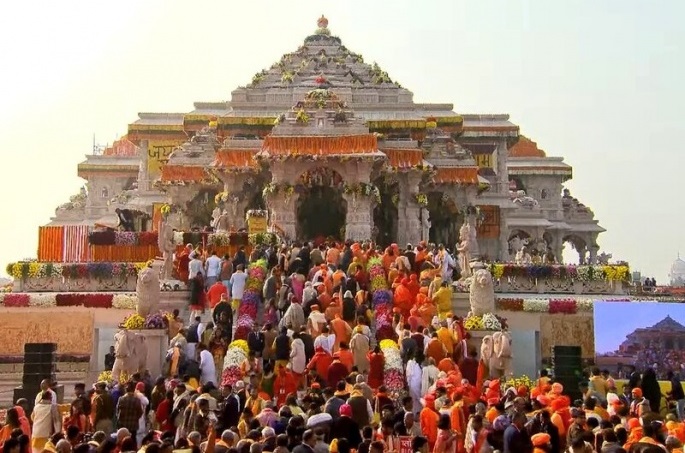
On January 22, 2024, in the heartland of India, a momentous event took place that reverberated across the nation and around the world, the re-consecration of the Lord Ram Hindu Temple in the Holy City of Ayodhya, India. This sacred occasion marked the culmination of a decades-long struggle, legal battles, and emotional upheavals, as the Hindu faithful witnessed the fulfillment of a resurrection, deeply embedded in the cultural and historical fabric of India.
Historical Context of the Holy City
Ayodhya, nestled on the banks of the revered Sarayu River, is not just a city; it is a symbol of ancient glory and spirituality. At the epicenter of Ayodhya is the Ram Janmabhoomi, the birthplace of Lord Ram, one of the most revered deities in Hinduism. The saga of the Ram Janmabhoomi has been etched in the collective consciousness of millions, as it became entangled in a complex web of historical disputes and communal tensions.
Holy City of Ayodhya, India
The original Hindu temple stood as a testament to devotion for centuries with the same religious significance as the Vatican for Catholics, Jerusalem for Jews and Mecca for Muslims. However, in the year 1528, it became a horrific flashpoint when the brutal armies of Islamic Central Asian Turkic Mughal Emperor, Bābur (from present day Uzbekistan and descendant of Mongol conqueror, Genghis Khan) invaded India and ordered the destruction of the temple and be replaced with a mosque at the same site in his honor.
Mughal Emperor, Bābur
The centuries that followed were marked by a series of disputes, protests, and legal battles, culminating in the demolition of the Bābur Mosque in 1992. The events that unfolded led to a prolonged legal battle that concluded with a landmark verdict by the Supreme Court of India in November 2019, granting permission for the construction of a grand Ram Temple at the disputed site.
The Re-Consecration of the Holy Temple
The re-consecration of the Lord Ram Temple was not merely the laying of bricks and mortar; it was a spiritual rejuvenation, a manifestation of resilience, and a celebration of the enduring spirit of a civilization that has endured terrible suffering.
The event was attended by millions, with devotees, political dignitaries, sports icons, film actors and religious representatives converging in the Holy City to witness the historic moment.
The religious rites of passage performed during the re-consecration were steeped in ancient traditions, meticulously following the guidelines prescribed in ancient scriptures. The sanctification ceremony, known as Maha Yagna, sought the blessings of the divine to infuse the temple with spiritual energy and sanctity. The chanting of Vedic hymns, the fragrance of incense, and the resonance of bells filled the air, creating an ethereal atmosphere that uplifted the attendees to divine transcendence.
Cultural and National Significance
The re-consecration of the Lord Ram Temple holds immense cultural and national significance. For Hindus, it symbolizes the restoration of a sacred space that had been lost for centuries. It is a moment of unbridled joy, a reaffirmation of faith, and a spiritual homecoming for millions who had yearned to see the grandeur of the Ram Temple.
The cultural importance of the event extends beyond religious boundaries. Ayodhya, often referred to as the birthplace of Indian civilization, holds diverse cultures and traditions. The re-consecration serves as a unifying force, bringing together people of different faiths and backgrounds in celebration of a shared heritage. It fosters a sense of unity and national pride, transcending the temporal boundaries that often divide societies.
Political Achievements
The political implications of the re-consecration cannot be overlooked. The Ayodhya dispute has been a contentious issue that has shaped Indian politics for decades. The successful resolution and construction of the Lord Ram Temple stand as a testament to the ability of democratic institutions to navigate complex challenges. The event has provided a platform for political leaders to showcase their commitment to cultural and religious harmony, fostering a narrative of inclusive governance.
India’s Prime Minister, Narendra Modi inside the Lord Ram Mandir
India’s Prime Minister, Narendra Modi in attendance led the “Pran Pratishta” ceremony. His memorable speech echoed public sentiment.
“January 22, 2024 is the beginning of a new era. A nation rising up after breaking the mentality of slavery, a nation taking courage from every bite of the past, creates a new history in this way.”
India’s Prime Minister, Narendra Modi
Even though this specific moment could be interpreted as a monumental victory over critics, political opponents and even the remnants of the Mughal Empire, the prime minister’s speech emphasised that this was not a moment of victory alone.
“For us, this is not a time of victory but also of humility. The history of the world is witness to the fact that many nations get entangled in their own history. Whenever such countries tried to untie the tangled knots of their history, they faced great difficulty in achieving success. In fact, many times situations became more difficult than before. But the seriousness and emotion with which our country has opened this knot of history, shows that our future is going to be much more beautiful than our past.”
India’s Prime Minister, Narendra Modi
The re-consecration of the Lord Ram Temple in Ayodhya on January 22, 2024, transcends the boundaries of religion and politics, weaving together a tapestry of spirituality, culture, and national pride. It signifies a triumph of perseverance, a testament to the resilience of a civilization that has weathered the storms of time. As the echoes of Vedic hymns reverberate through the air, the re-consecrated Lord Ram Temple stands not just as a physical structure but as a beacon of faith, hope, unity, good overcoming evil and the enduring interwoven spirit of Ancient and Modern India.


 juni
juni 
OPINION |
Ram, Ram. A warm greeting said by millions around the world with care, respect and well wishes.
The person attributed with this greeting is Valmiki, an ancient Indian sage and poet. He is revered as the author of the Sanskrit scripture, the Ramayana, an epic that narrates the life of Lord Ram, his wife Sita, his brother Lakshman and his loyal companion, Hanuman, with strikingly similar abilities to the Nephilim.
Sage Valmiki is not only known for his contribution to literature but also for his teachings on righteousness and his role in the cultural and spiritual heritage of the oldest religion in the world, Hinduism.
On January 22, 2024, in the heartland of India, a momentous event took place that reverberated across the nation and around the world, the re-consecration of the Lord Ram Hindu Temple in the Holy City of Ayodhya, India. This sacred occasion marked the culmination of a decades-long struggle, legal battles, and emotional upheavals, as the Hindu faithful witnessed the fulfillment of a resurrection, deeply embedded in the cultural and historical fabric of India.
Historical Context of the Holy City
Ayodhya, nestled on the banks of the revered Sarayu River, is not just a city; it is a symbol of ancient glory and spirituality. At the epicenter of Ayodhya is the Ram Janmabhoomi, the birthplace of Lord Ram, one of the most revered deities in Hinduism. The saga of the Ram Janmabhoomi has been etched in the collective consciousness of millions, as it became entangled in a complex web of historical disputes and communal tensions.
The original Hindu temple stood as a testament to devotion for centuries with the same religious significance as the Vatican for Catholics, Jerusalem for Jews and Mecca for Muslims. However, in the year 1528, it became a horrific flashpoint when the brutal armies of Islamic Central Asian Turkic Mughal Emperor, Bābur (from present day Uzbekistan and descendant of Mongol conqueror, Genghis Khan) invaded India and ordered the destruction of the temple and be replaced with a mosque at the same site in his honor.
The centuries that followed were marked by a series of disputes, protests, and legal battles, culminating in the demolition of the Bābur Mosque in 1992. The events that unfolded led to a prolonged legal battle that concluded with a landmark verdict by the Supreme Court of India in November 2019, granting permission for the construction of a grand Ram Temple at the disputed site.
The Re-Consecration of the Holy Temple
The re-consecration of the Lord Ram Temple was not merely the laying of bricks and mortar; it was a spiritual rejuvenation, a manifestation of resilience, and a celebration of the enduring spirit of a civilization that has endured terrible suffering.
The event was attended by millions, with devotees, political dignitaries, sports icons, film actors and religious representatives converging in the Holy City to witness the historic moment.
The religious rites of passage performed during the re-consecration were steeped in ancient traditions, meticulously following the guidelines prescribed in ancient scriptures. The sanctification ceremony, known as Maha Yagna, sought the blessings of the divine to infuse the temple with spiritual energy and sanctity. The chanting of Vedic hymns, the fragrance of incense, and the resonance of bells filled the air, creating an ethereal atmosphere that uplifted the attendees to divine transcendence.
Cultural and National Significance
The re-consecration of the Lord Ram Temple holds immense cultural and national significance. For Hindus, it symbolizes the restoration of a sacred space that had been lost for centuries. It is a moment of unbridled joy, a reaffirmation of faith, and a spiritual homecoming for millions who had yearned to see the grandeur of the Ram Temple.
The cultural importance of the event extends beyond religious boundaries. Ayodhya, often referred to as the birthplace of Indian civilization, holds diverse cultures and traditions. The re-consecration serves as a unifying force, bringing together people of different faiths and backgrounds in celebration of a shared heritage. It fosters a sense of unity and national pride, transcending the temporal boundaries that often divide societies.
Political Achievements
The political implications of the re-consecration cannot be overlooked. The Ayodhya dispute has been a contentious issue that has shaped Indian politics for decades. The successful resolution and construction of the Lord Ram Temple stand as a testament to the ability of democratic institutions to navigate complex challenges. The event has provided a platform for political leaders to showcase their commitment to cultural and religious harmony, fostering a narrative of inclusive governance.
India’s Prime Minister, Narendra Modi in attendance led the “Pran Pratishta” ceremony. His memorable speech echoed public sentiment.
Even though this specific moment could be interpreted as a monumental victory over critics, political opponents and even the remnants of the Mughal Empire, the prime minister’s speech emphasised that this was not a moment of victory alone.
The re-consecration of the Lord Ram Temple in Ayodhya on January 22, 2024, transcends the boundaries of religion and politics, weaving together a tapestry of spirituality, culture, and national pride. It signifies a triumph of perseverance, a testament to the resilience of a civilization that has weathered the storms of time. As the echoes of Vedic hymns reverberate through the air, the re-consecrated Lord Ram Temple stands not just as a physical structure but as a beacon of faith, hope, unity, good overcoming evil and the enduring interwoven spirit of Ancient and Modern India.
Jai Shri Ram.
This work is licensed under a Creative Commons Attribution-NonCommercial-NoDerivatives 4.0 International License